
News
Underfoot and On the Wall: A Journey Through Early Ceramic Tiles
Posted On: 13 Jul 2026 by Franki Falkow to BlogFrom Gothic Revival encaustics to Dutch Delft and William De Morgan - a look at the early ceramic tiles coming up in our July Antiques & Collectors Auction, with plenty of Staffordshire pottery history along the way.

A JOURNEY THROUGH EARLY CERAMIC TILES
Underfoot and On the Wall

There's something quietly magical about a tile. Unlike a painting or a piece of porcelain, a tile is rarely made to be admired alone. It is designed to repeat, to tessellate, to disappear into a pattern bigger than itself, whether that's a cathedral floor, a fireplace surround, or a Delft kitchen wall. And yet, pick one up on its own and you're holding a small slab of social history: the fashions, beliefs, technologies and travels of the people who made it and the people who walked, cooked, and prayed beside it.
This July, we're delighted to be offering a wonderful single-owner collection of tiles spanning over 600 years of history in our July Antiques & Collectors Auction (Online Only), held here in Stone, Staffordshire on Saturday 18th July 2026, from 9:30am. It's a collection with real breadth. From medieval-inspired Gothic Revival encaustics to Dutch Delft blue-and-white, from the earliest days of transfer printing to the exuberant Arts and Crafts genius of William De Morgan. And fittingly, given where we're sat here in the heart of the Potteries, several of the lots have a distinctly Staffordshire story to tell.
A Very Short History of the Tile
Tile-making stretches back thousands of years, but the story of the decorated ceramic tile as we'd recognise it in a British collection really begins with the medieval "encaustic" tile, a technique in which a pattern is pressed into wet red clay, then filled with a contrasting pale slip before firing and glazing, so the design is literally baked into the tile rather than painted on top. Encaustic tiles paved the floors of abbeys, monasteries, and royal palaces across medieval England, but the skill was largely lost following the dissolution of the monasteries in the sixteenth century.
Meanwhile, on the continent, a completely different tradition was flourishing: tin-glazing. Potters in Spain, Italy and later the Netherlands discovered that adding tin oxide to a lead glaze produced a brilliant opaque white surface, the perfect blank canvas for hand-painted decoration. This "maiolica" or "faience" tradition travelled north through the sixteenth and seventeenth centuries and found its most famous home in the Dutch town of Delft, which lent its name to the blue-and-white tin-glazed pottery and tiles produced there in vast quantities.
By the eighteenth century, a new technological leap arrived: transfer printing, which allowed an engraved copper plate to stamp a detailed inked design onto paper, and from paper onto the glazed tile. A process that was dramatically faster than hand-painting and opened tile decoration up to intricate scenes that no brush could easily replicate.
Then came the Gothic Revival of the nineteenth century, when architects like Augustus Welby Pugin and Sir George Gilbert Scott, restoring and building churches across Britain, revived the medieval encaustic technique almost from scratch. And it's here that Staffordshire truly enters the story.
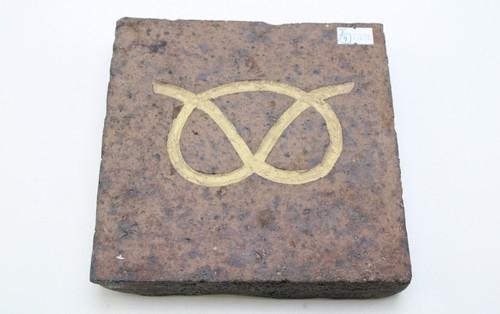
Lot 123 - 19th century quarry floor type tile with Stafford Knot design
Home of the Potteries
It would be remiss of us, sat here in Stone, not to dwell for a moment on our own patch. Stoke-on-Trent and its surrounding towns became, by the nineteenth century, the beating heart of British ceramics - "the Potteries" - and nowhere was that more true than in encaustic tile manufacture. When Herbert Minton of Thomas Minton & Sons in Stoke-upon-Trent began experimenting with encaustic tiles in the 1830s, working closely with Pugin himself, he helped kick-start an entire industry that would go on to tile churches, town halls and railway stations the length and breadth of the country. Pugin worked so closely with Minton that in 1852 he wrote to Herbert Minton declaring the tiles made for St Stephen's "the finest done in the tile way, vastly superior to any ancient work." It's a rare and lovely thing to be able to trace that same Staffordshire ingenuity into lots in our own saleroom nearly two centuries later.
With that scene set, let's take a closer look at some of the outstanding lots in this collection.
Lot 106: A Godwin Tile from a George Gilbert Scott Restoration
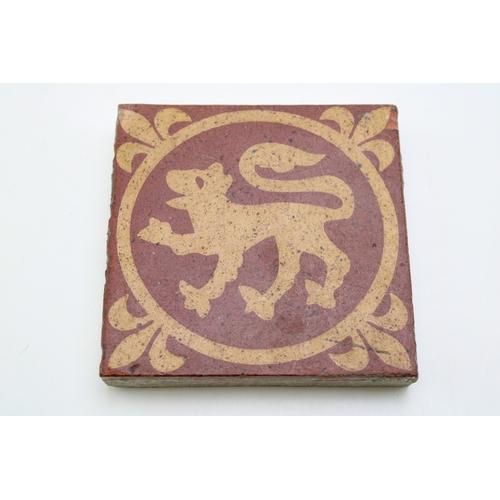
Our first highlight is an encaustic glazed floor tile in the Gothic Revival style, depicting a lion passant amid fleurs-de-lys, salvaged from St John the Baptist Church in Cirencester, laid there under the direction of the great Victorian church architect Sir George Gilbert Scott. The tile was made by William Godwin & Sons of Hereford, one of the giants of Victorian encaustic tile production.
William Godwin began making encaustic tiles at Lugwardine, near Hereford, in the early 1850s, and by 1863 had expanded to a second, larger factory at nearby Withington. Within a few years the firm had become a major supplier of encaustic tiles for churches, town halls, railway stations and other public places, and remained so throughout the Victorian period. Godwin's tiles were prized in particular for their authenticity to medieval originals, so much so that they were reputed to be favoured above those of other manufacturers by architects George Gilbert Scott and G.E. Street in their many church restoration projects. A Godwin tile with a documented Gilbert Scott provenance, salvaged from an actual restoration, is a genuinely special survival - a physical fragment of one of the great church-building partnerships of the Victorian age.
Lot 107: Sadler & Green - Tiles at the Dawn of Transfer Printing
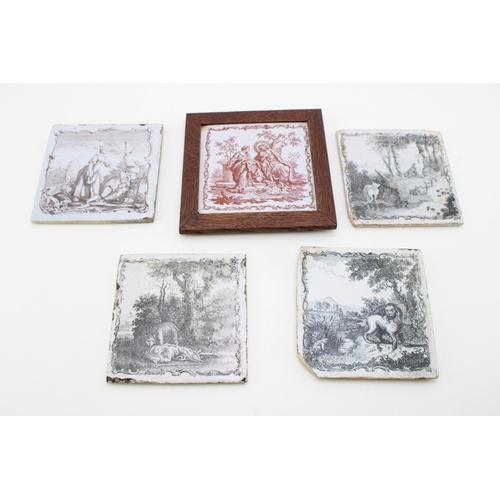
Lot 107 brings us a set of five tin-glazed earthenware tiles, likely made in Liverpool or Holland in the 1760s/70s, which depict scenes from Aesop's Fables. These are especially interesting because they represent some of the very earliest surviving examples of transfer-printed tiles anywhere.
The firm behind the technique, Sadler & Green, was formally established by John Sadler and Guy Green in 1761, though the two had actually been perfecting transfer printing on tin-glazed tiles together since 1756. Their innovation was staggering in its efficiency: they claimed to be able to decorate more than 1,200 tiles in just six hours, a speed utterly unmatched by traditional hand-painting. Also known as "Liverpool tiles", their work is charming, detailed, and historically pivotal. This was the moment ceramic decoration shifted from the exclusive preserve of the skilled painter to something that could be reproduced, quickly and consistently, again and again. Sadler retired in 1770, but Green carried the business on for at least another decade.
Lots 109–116: Dutch Delft Blue and White
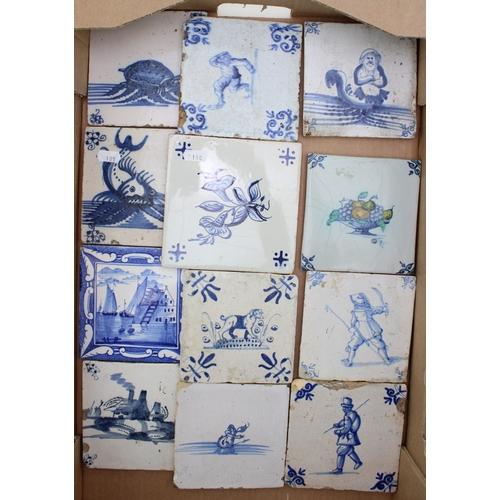
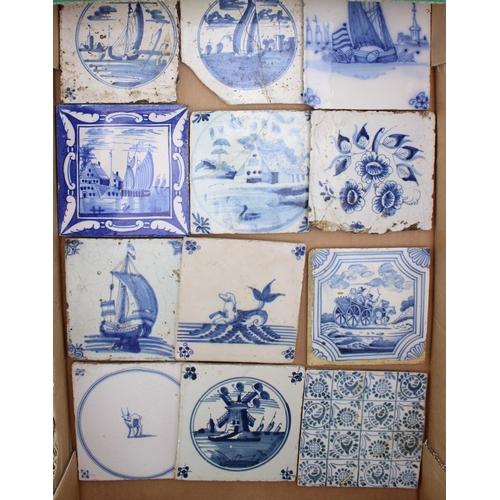
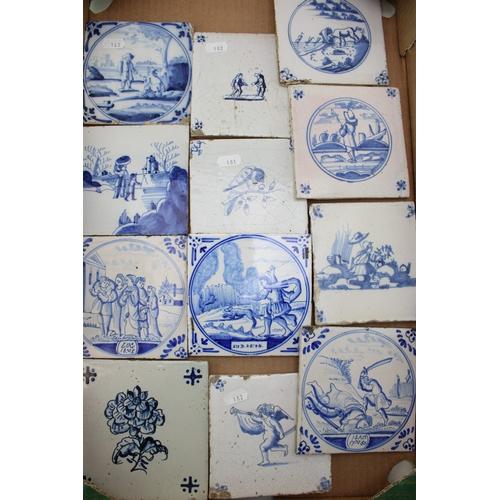
Seven further lots bring together groups of antique blue-and-white Dutch tiles, depicting sailing ships, flowers, garden scenes, mermaids and other traditional motifs.
Delftware takes its name from the Dutch town of Delft, which became the centre of tin-glazed pottery production in the Netherlands from the seventeenth century onward, as Dutch potters absorbed and reinterpreted the blue-and-white porcelain arriving from China via the Dutch East India Company. Tiles were made in their millions across the seventeenth and eighteenth centuries, largely for lining kitchens, hallways, dairies and fireplace surrounds - both to protect the wall and to reflect what light there was in these often dim, damp interiors. Individual tiles were typically hand-painted freehand in cobalt blue over a white tin glaze, meaning that even the simplest "filler" tiles produced for everyday houses carry a wonderful spontaneity of brushwork, while more elaborate scenic tiles were often copied from prints and pattern books. Corner motifs, commonly a stylised "ox-head" or spider design, helped align tiles when laying a wall, a small practical detail that's become one of the most recognisable features of the genre. Grouped together as they are here, this run of lots offers a lovely, affordable way into a tradition that graced Dutch interiors, and, via the East India trade, country houses across Britain for the best part of two centuries.
Lot 117: William De Morgan - Arts and Crafts at its Finest
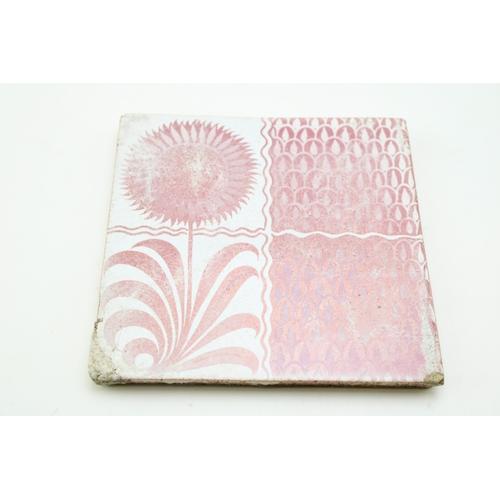
Perhaps the star of the collection is Lot 117: a William De Morgan sunflower tile from his early Fulham period, made between 1888 and around 1897, with the impressed mark "W De Morgan & Fulham Pottery" to the reverse.
William De Morgan is one of the true greats of British decorative art, a lifelong friend of William Morris and a central figure in the Arts and Crafts movement. In 1888, with financial backing from his wife, the painter Evelyn De Morgan, and a new partnership with the architect Halsey Ricardo, De Morgan moved his pottery from Merton Abbey to Sands End in Fulham. It was during this Fulham period that De Morgan finally mastered many of the technical challenges that had eluded him for years, including his celebrated complex lustre glazes and richly saturated underglaze painting that held its colour through firing. Sunflowers were a favourite Arts and Crafts motif; bold, architectural, unmistakably late-Victorian in spirit, and a De Morgan tile from this golden Fulham period, in good condition and clearly marked, is a genuinely exciting thing to see come to auction. It's easy to see why this lot has already attracted plenty of interest.
Lot 126: The Lamb of God, in the Manner of Pugin
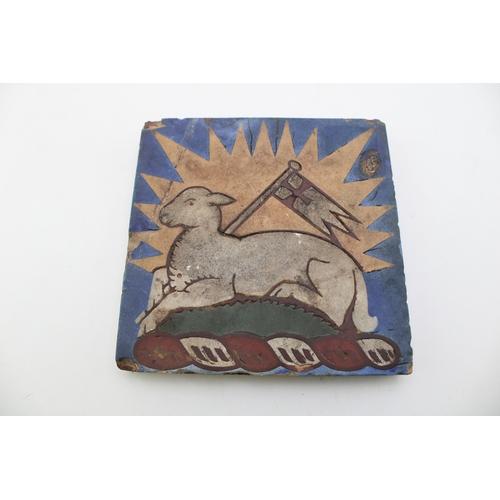
Lot 126 is a late nineteenth-century encaustic tile depicting the Lamb of God (Agnus Dei), likely made by Robert Minton Taylor at the Fenton Works, in the manner of A.W.N. Pugin.
Robert Minton Taylor's own story is a very Staffordshire tale of family rivalry: he joined the Minton tile business in the early 1860s before striking out on his own, later entering partnership to form the Campbell Brick & Tile Co. His Fenton Works tiles carried forward the Gothic Revival tradition that Pugin and Herbert Minton had pioneered decades earlier, devotional and heraldic motifs, rendered with real reverence for medieval originals. Destined for the chancels and naves of churches being restored or newly built across Victorian Britain. The Lamb of God, a potent symbol of sacrifice and redemption, would have been a natural choice for an ecclesiastical floor or wall scheme.
Lot 127: Josiah Wedgwood and Sons
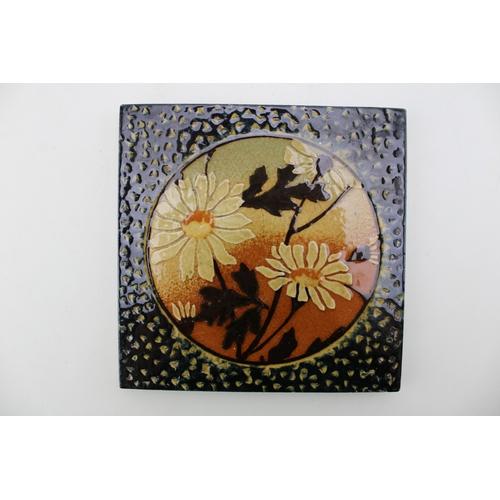
Rounding off the collection is Lot 127, a Josiah Wedgwood and Sons tile, pattern number R1551, decorated with flowers framed within a circular design. No survey of Staffordshire ceramics would be complete without a nod to Wedgwood, a name so synonymous with the county's pottery heritage that it needs little introduction. This later, elegant floral pattern is a reminder that tile-making in the Potteries continued to evolve long after the Gothic Revival had run its course, into the more decorative, domestic wares that furnished Edwardian and early twentieth-century homes.
A Collection Worth Seeing
From a salvaged Gothic Revival floor tile with a direct link to one of Victorian Britain's greatest church architects, through the earliest days of transfer printing, the enduring charm of Dutch Delft, and on to the dazzling colour of William De Morgan, this is a collection that tells the story of ceramic decoration in miniature. And, appropriately, one being sold from right here in the heart of Staffordshire's pottery country.
The July Antiques & Collectors Auction takes place on Saturday 18th July 2026 from 9:30am, here at Leighton Hall Auctions in Stone, Staffordshire. Full catalogue details and bidding are available online now - whether you're a seasoned tile collector or simply drawn to a little piece of history for your own home, there's something in this collection to catch the eye.
Browse the full catalogue on our website, and do get in touch if you have any questions ahead of the sale.
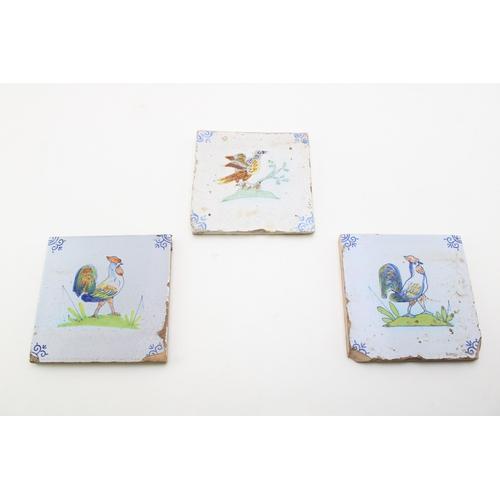
Lot 122 - Three 17th century Dutch Delft, polychrome tiles, depicting birds
Your Hidden Treasure Could Be Next
Whether it’s a piece of fine jewellery, decorative arts, or an unusual item like this synthesizer, Leighton Hall Auctions in Staffordshire offers a personal yet professional approach to every consignment.
We’re based in Stone, Staffordshire, but our reach is global—and we welcome entries from across the country for our specialist sales.
Thinking of Selling?
If you have something you think might be rare, unusual, or simply beautiful, we’d love to hear from you. Our friendly team offers free, no-obligation valuations and can guide you through the auction process with transparency and care.
📞 Call us on 01785 561799
📧 Email info@leightonhallauctions.com
📍 Or pop in to see us at our saleroom in Stone.